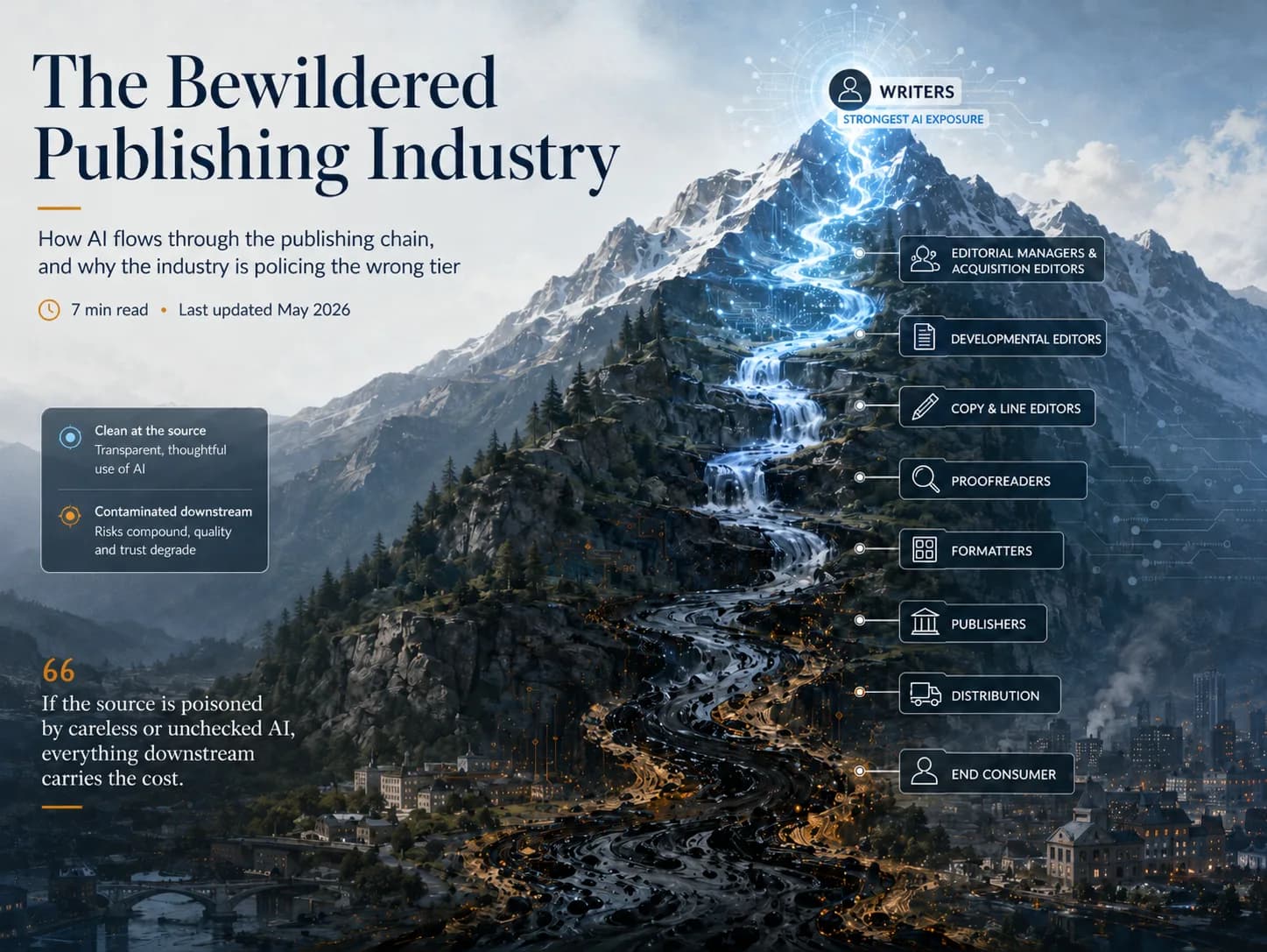
Imagine a mountain. Water collects at the peak and runs downhill through every tier below, feeding each stream in turn before it reaches the valley floor. Publishing is built much the same way. Writers sit at the summit, and everything they produce, every sentence, every argument, every flicker of voice, flows down into the hands of the editors, the proofreaders, the formatters, and the publishers before it ever lands with a reader.
AI has settled into every level of this watershed. Editors lean on it for style checking. Proofreaders use it to catch errors at scale. Publishers run it across metadata, rights analytics, and market forecasting. There is nothing remarkable in any of that; tools have always found their way into the workflow. What counts is where the use carries the most weight, and that is right at the top of the mountain, with the writers. Which is exactly where the industry’s anxiety is at once completely understandable and badly aimed.
If AI quietly writes the manuscript, every conscientious editor downstream is shouting in a forest, one they are slowly losing the right to stand in.
The logic is simple hydrology. When the source water is contaminated, it hardly matters how good the filters are further down. You can hand a manuscript to the most principled copy editor in the business, someone who agonises over every comma, every citation, every passive construction, and it changes nothing fundamental if the raw text was largely produced by a language model with no real authorial intent behind it. The contamination travels with the current.
Where the usual responses go wrong
The industry’s first instincts on AI-generated writing have tended to be performative, a little naive about how the chain actually works, or quietly hypocritical. Sometimes all three at once.
There is a fair amount of this going around the editorial middle of the industry: a quiet competition to show, in public, that one’s hands are the cleanest in a dirty room. It misreads the problem. How a copy editor uses a tool matters far less than what lands on that editor’s desk to begin with. When a manuscript has been generated at industrial scale with little authorial engagement, no amount of careful proofreading can put back a human voice that was never really there.
There is some awkwardness in it, too. Most working editors already reach for AI-assisted grammar tools, style checkers, and increasingly structural analysis software. Condemning the same technology upstream while leaning on it downstream tends to read as protectiveness about price rather than principle.
Publishers face their own version of this. A house that uses AI to triage its slush pile, tune its catalogue metadata, and model its rights licensing has little standing to bar AI from the writing process on ethical grounds. What it does have is the standing, and the means, to lead the structural reform the industry actually needs.
Three things that would actually help
Whatever this moment is, it reads less as an AI crisis than an accountability one, and AI has simply made it impossible to keep ignoring. The water runs downhill, the way it always has. The only question worth asking is what kind of water we choose to send from the top.